
The Splint Isn’t the Treatment. It’s the Waiting Room.
You were told to wear the splint and rest. So you did.
Six weeks on, you still pass the kettle to your other hand. You still wince picking up your baby, or the trowel, or the phone. And week 6 looks a lot like week 1.
That’s not the splint failing. A splint stops you irritating two thumb tendons while they calm down. It was never going to teach those tendons to lift a 9 kg toddler again. Nothing you wear does that.
And here’s the bit many patients miss: a tendon that’s only ever been rested comes out WEAKER than it went in. Then it gets handed the same baby, the same pan, the same phone. Of course it flares.
(The three things I correct most often in clinic: a wrist brace that leaves the thumb free, which does roughly nothing for De Quervain’s…a splint worn 24/7 for 3 months with no plan to come out of it…and nobody ever showing the person when or how to load the tendons again.)
What’s in the workbook
A 6-week plan in 10 short chapters, 20 pages, with a printable daily log at the back. Read it in an evening, use it for 6 weeks.
- Why your De Quervain’s wrist isn’t getting better. The three mistakes, and the eight ways people end up with this: babies, phones, keyboards, kitchens, trades, sport, a sudden jump in load, pregnancy.
- Is it De Quervain’s? The self-check every hand clinic uses, and the four signs it’s something else.
- The splint, done properly. Why it has to be a long thumb spica, not a wrist brace or a short one, and the hours per phase: weeks 1 to 2, 3 to 4, 5 to 6. The part many patients miss.
- Load. What to stop, what to change, what’s fine. Lifting a baby without the thumb. Phone. Keyboard. Kitchen. Car seats.
- Weeks 1 to 2: calm. Weeks 3 to 4: move. Weeks 5 to 6: load. Each with the exercises, the reps, the pain rule and the stop rule.
- The week 6 test. Three checks that tell you whether you’re through, need two more weeks, or need Chapter 9.
- Keeping it gone. Three habits.
- If it’s not working. Injection and surgery explained honestly, what each actually does, and the questions to ask your doctor.
- The 6-week log. Print it. One line a night.
A tendon that’s only ever rested has only ever learned to rest.
Who it’s for
You’ve had thumb-side wrist pain for 3 weeks or more. You’ve been told, or strongly suspect, it’s De Quervain’s. You’ve tried a splint. You’d like to avoid an injection if you can, and you want to know what to actually DO, week by week, rather than wait.
New parents, in particular. The way most people lift a baby is close to the exact position these tendons hate, 50 times a day, with the load going up every month. The workbook changes the lift, not the baby.
Who it isn’t for
- Wrist pain that started with a fall onto the hand. That’s a possible fracture or sprain, and an X-ray comes first.
- A wrist that’s hot, red and swollen, or a fever. That’s a doctor today.
- Anyone who wants a promise. The workbook explains the window De Quervain’s runs on and how to use it. It doesn’t promise an outcome, cos nobody honestly can.
Who wrote it
Nigel Chua, hand occupational therapist in practice since 2005. Thousands of hands, wrists and elbows assessed and treated. My credentials are here. I don’t publish patient reviews or recovery stories as advertising; the credential and the content are the proof.
If you want to see how I write about this condition before you buy, read De Quervain’s: symptoms, treatment and how long it takes, and the week-by-week for De Quervain’s release surgery recovery. The workbook is those pages turned into a plan you follow.
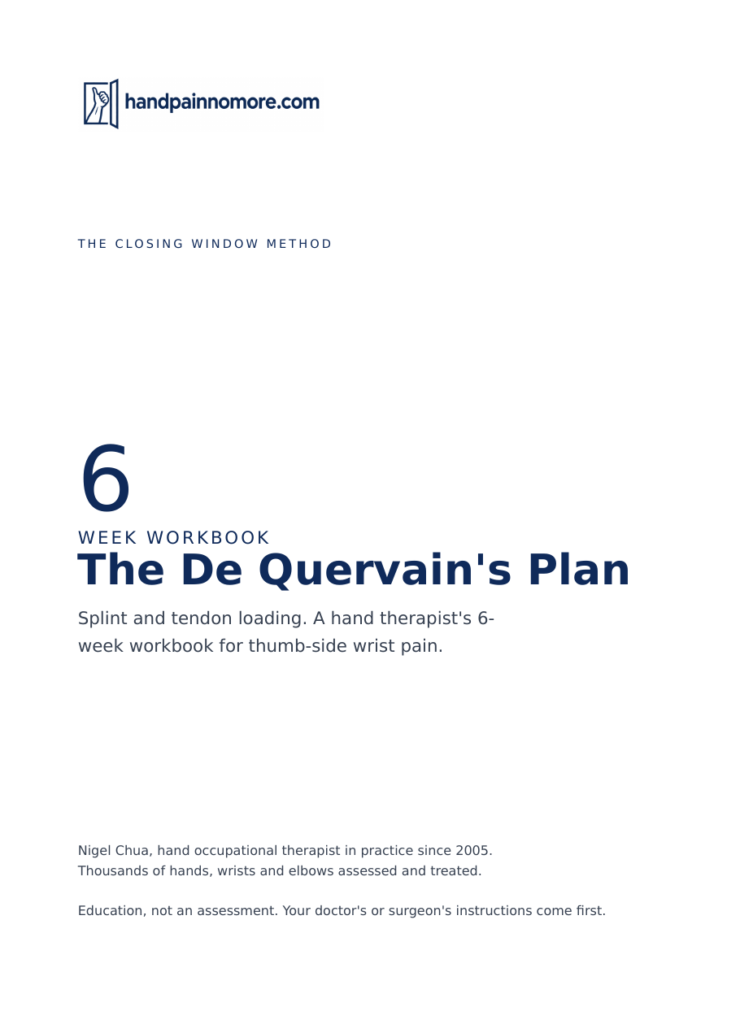
The workbook
The De Quervain’s Plan. 20-page PDF, delivered by email the moment you pay, with the printable log. $27.
If the workbook doesn’t help you understand your condition and what to do about it, email me within 90 days for a full refund.
Questions
I’m pregnant or breastfeeding. Can I use it? The splint and load chapters, yes, from today. Any medicine or injection goes through your doctor first, and the workbook says so.
I’ve already had an injection. Then you’re in the quiet weeks the injection bought. The workbook is what you do with them.
Does it replace seeing someone? No. It explains; it doesn’t examine. If a doctor or hand therapist has given you a plan, theirs comes first wherever it differs.
You don’t need to fear your thumb. You need to lift with the rest of your arm.
This workbook is education, not an assessment or a diagnosis. Your doctor’s or surgeon’s instructions come first wherever they differ. It is written using the Closing Window Method: name the window your condition runs on, find where you are in it, and act while it’s still open.