
Weak at Month 3 Is the Middle of the Story. Stiff at Week 6 Is a Phone Call.
Three months after the trapeziectomy, the arthritis pain has mostly gone. That’s what the operation does best.
And the thumb feels loose, unstable, with no power in it. Buttons are hard. The jar lid waits for whoever’s home. A key is a struggle. On a pinch gauge, strength is often LOWER than before surgery.
This is the single most common reason someone books in with me convinced their surgery has failed. It hasn’t. The thumb was held still for six weeks, the muscles that steady it have wasted, and the scar cushion that replaced the bone hasn’t toughened yet. Strength dips below where it started before it climbs above it. The climbing part is the second half of the year.
Here’s the problem with “give it time.” It’s the right answer for weakness and the wrong answer for almost everything else. Fingers that stiffened while the thumb was splinted. A thumb web space that tightened quietly. A scar stuck to what’s underneath. Pain that’s climbing instead of settling. Those run on short clocks, and they look a lot like the slow-but-fine kind in the early months.
(The pattern I see over and over: the thumb is protected beautifully, and nobody tells the patient the fingers aren’t meant to be. By the time the splint comes off, the index finger can’t make a fist. That was fixable at week 4. At month 6 it’s a project.)
What’s in the guide
A 12-month recovery guide in 13 chapters, 23 pages, with a printable weekly log at the back. Read it in an evening, use it for a year.
- Start here: where are you right now? Eight situations, from “surgery booked” to “over a year and still sore,” each pointing to the chapter that was written for it.
- The three clocks. Strength runs long. Fingers, web space and scar run short. CRPS is the alarm. A one-page table of which problem runs on which window and what to do in it.
- Week by week, with stop rules. Days 0 to 3, weeks 1 to 2, 2 to 6, 6 to 8, 8 to 12, months 3 to 6, months 6 to 12. Each with what’s normal, your job, and the line where you do less or make a call.
- Keeping the rest of the hand. The 10 minutes a day that stop the most avoidable problem in this whole recovery.
- The splint, and getting out of it. Wearing, weaning, and why the thumb feels like someone else’s the first time it comes off.
- The scar and the numb patch. Massage, silicone, the skin nerve that crosses the scar, and the 6-month window the scar changes in.
- The month 3 problem, and getting pinch back. The order things return, control before force, and a six-step pinch sequence with reps and the stop rule for each step.
- Measuring at home. Five checks with no equipment, so you can see progress on paper weeks before you feel it.
- Is this normal? Honest. Including the things that aren’t.
- If it isn’t going to plan. A sorting table, the usual suspects when it still hurts at a year, and how common each complication is, in plain numbers.
- When can I…? Drive, type, cook, lift, soak the wound, judge the result.
- What not to do, and the red flags.
- The weekly log. Print it. Bring it to every review.
Pain relief arrives in months. Strength arrives in seasons.
Who it’s for
You’ve had a trapeziectomy, with or without a tendon sling or suspension, or you have one booked. Your next surgeon review is weeks away and you want to know what to actually DO between now and then, and which of the things you’re noticing need a call rather than patience.
Especially if you’re at month 2 to 4, the pain has gone and the strength hasn’t come, and you’re starting to wonder.
Who it isn’t for
- Anyone whose surgeon has given them a protocol that differs from this. Theirs wins, every time, and the guide says so on page one.
- A hand that’s getting MORE painful after week 2, shiny, swollen or changing color. That’s a surgeon today, not a book.
- Anyone who wants a promise. The guide explains the windows this recovery runs on and how to use them. It doesn’t promise an outcome, cos nobody honestly can.
Who wrote it
Nigel Chua, hand occupational therapist in practice since 2005. Thousands of hands, wrists and elbows assessed and treated. My credentials are here. I don’t publish patient reviews or recovery stories as advertising; the credential and the content are the proof.
If you want to see how I write about this operation before you buy, read trapeziectomy recovery time, week by week, trapeziectomy with suspensionplasty, the trapeziectomy scar and the numb patch and trapeziectomy complications. The guide is those pages turned into one reading order, with the stop rules, the pinch sequence, the home measures and the log that the articles don’t have.
The guide
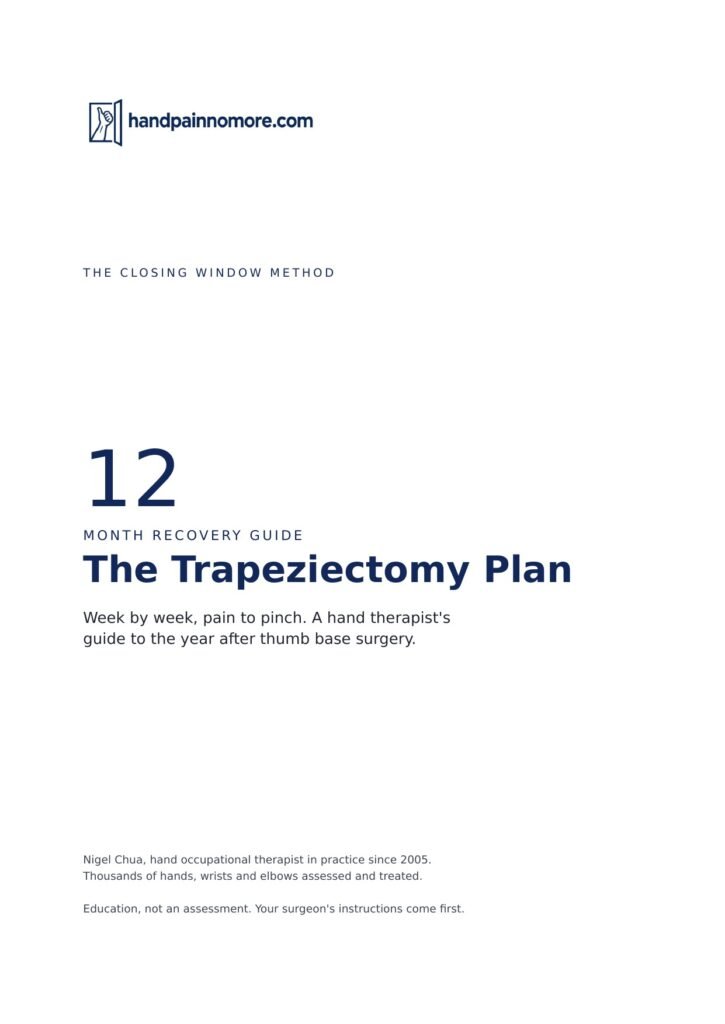
The Trapeziectomy Plan. 23-page PDF, delivered by email the moment you pay, with the printable weekly log. $27.
If the guide doesn’t help you understand your recovery, email me within 90 days for a full refund.
Questions
I had a sling or suspension (LRTI, APL, suture button). Does it apply? Yes. The timeline is the same clock. Where the sling changes something, like forearm ache where tendon was taken or an earlier start to movement with some suture-button techniques, the guide says so.
I’m already at month 6 or later. Then start at chapter 7 and chapter 10. Strength can still be built in the second half of the year, and the guide shows you how to tell slow-but-fine from stuck.
Does it replace seeing someone? No. It explains; it doesn’t examine. Your surgeon’s protocol comes first wherever it differs, and several pages tell you when to ask for a hand therapy referral rather than wait.
A weak thumb at month 3 is the middle of the story. Judge the operation at a year.
This guide is education, not an assessment or a diagnosis. Your surgeon’s instructions come first wherever they differ. It is written using the Closing Window Method: name the window your condition runs on, find where you are in it, and act while it’s still open.